GSoC 2026: Portable data-parallel primitives for the Julia GPU stack
Shreyas Hegde
This Google Summer of Code 2026 project added the data-parallel primitives that the Julia GPU stack was missing and tuned them to serve as the shared implementation for every backend. The work was merged as 15 pull requests in AcceleratedKernels.jl 0.5. Each operation is benchmarked on an NVIDIA RTX 5080 against the pre-GSoC AK release and the CUDA.jl vendor path, showing real speedups where a better algorithm applies, new functionality where AK had nothing before, and parity on the bandwidth-bound operations.
This post is my Google Summer of Code 2026 final report for The Julia Language (JuliaGPU), mentored by Tim Besard and Christian Guinard. It covers the project goals, what I did, what was merged, the benchmark results for each operation, and what is left.
The problem
The Julia GPU ecosystem lets users write array programs that run on NVIDIA, AMD, and Intel GPUs. That portability relies on GPUArrays.jl, which defines the common interface every vendor package implements. Several common operations did not have a shared implementation. reverse, findall, accumulate!, and mapreduce either failed on backends with no vendor-specific method, or fell back to CPU execution by copying data to the host and back. A source review of GPUArrays.jl, CUDA.jl, AMDGPU.jl, oneAPI.jl, and Metal.jl confirmed the gaps: reverse and findall were missing from the shared fallback, accumulate! existed only as a scalar CPU fallback, and mapreducedim! was an error("Not implemented") stub, so each backend carried its own copy.
The project addresses these gaps by moving the kernels into AcceleratedKernels.jl (AK), which is written once against KernelAbstractions.jl and runs on every backend, and by keeping GPUArrays.jl as a thin layer that delegates to it. Because Julia's multiple dispatch selects the most specific method, routing the AnyGPUArray fallback to AK means a backend that already has a vendor method keeps it, while a backend without one receives the AK implementation instead of an error or a host round trip.
Project goals
The goals I set with my mentors were:
Add the missing data-parallel primitives (
reverse,findall,accumulate,mapreduce, and thesortfamily) as portable AK kernels, so GPUArrays.jl can use one implementation instead of each backend maintaining its own.Add dimension-wise (
dims) support across these operations, since array code reduces, scans, reverses, and sorts along an axis, not only over a flat vector.Tune the kernels so the portable path is at least as fast as the vendor and
Baseimplementations, and add further sort algorithms where one strategy does not fit every input shape.Run a benchmark across every operation to check for regressions and to find where tuning is still required.
What I did
I merged the work as 15 pull requests, released in AcceleratedKernels.jl 0.5. AK 0.5 also reworked the host API (algorithms passed as values, an Auto() selector that chooses a strategy per input, and explicit workspaces), so every operation now has one calling convention across backends.
Primitives and dims support. Vendor packages already provided dimension-wise (dims) support for some of these operations on their own array types; the portable AK kernels did not. I added that coverage to AK so it can stand in for the per-backend versions and improve on them rather than regress them: I gave reductions and scans N-dimensional axis handling, added reverse and then extended it to arbitrary dims, built findall as a scan-based stream compaction, and generalized map and map! to take several source arrays.
Sorting. A single comparison sort is not the best choice for every shape, since it is good on short slices but grows as L log L on long ones. I added an opt-in least-significant-digit (LSD) RadixSort and tuned it with portable, capability-gated changes (a larger block size, atomic histograms, chunked scatter), added a BitonicSort network for short slices, and added a segmented RadixSort path for sorting along dims whose cost depends little on slice length. The Auto() selector chooses between them per input.
Benchmarking. I measured each operation on the same data on an NVIDIA RTX 5080, timing on the device with CUDA.@elapsed and taking the minimum of 12 warmed runs. For mutating operations, I refreshed the input each iteration. Every run used AK's default settings with no per-device tuning. I compare each operation against the state of AcceleratedKernels before the project and against the CUDA.jl vendor path. The "before" numbers come from checking out AK at the exact commit just before this work began (bfe4d84, the v0.4.3 line) and profiling it on the same machine. The results per operation follow.
Results by operation
In every chart, lower time is better, and both axes use a logarithmic scale unless noted. The series are:
Before GSoC (AK v0.4.3): the state of AcceleratedKernels before this work. For the operations AK already had (
sort,sortperm,reduce,accumulate,map, and reduction alongdims), this is the pre-GSoC AK kernel. Forreverseandfindall, AK had no kernel at all before this project, so there is no pre-GSoC AK line and the before-state is the CUDA.jl path shown instead.CUDA.jl: the vendor GPU implementation that already shipped, reached by calling the standard function on a
CuArray(through CUDA.jl and GPUArrays.jl).AK (this work): the current AcceleratedKernels.jl kernel.
One thing to set out up front: pre-GSoC AK was already a capable library. For some operations the result is a clear speedup, for others it is functionality that did not exist before, and for the bandwidth-bound operations it is parity with no regression. I call out each case below.
Sort
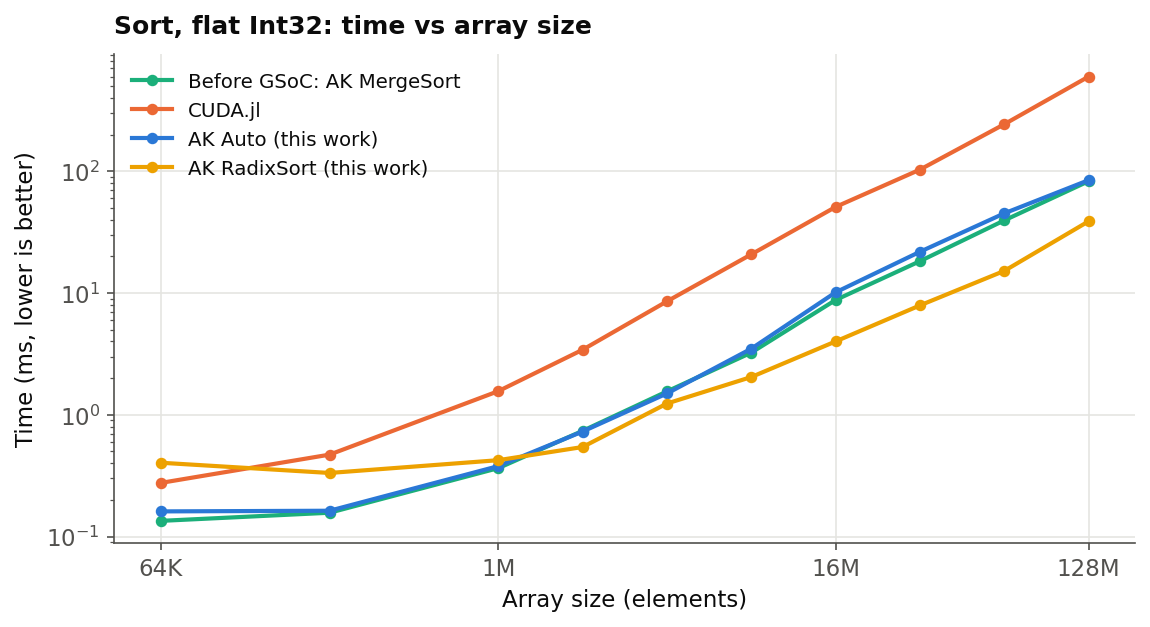
Pre-GSoC AK already had a MergeSort that was well ahead of the CUDA.jl sort (about 6 to 7 times faster at large sizes). The contribution here is the new RadixSort, which is about twice as fast as the old MergeSort on large integer arrays (at 128M Int32, 83 ms for MergeSort versus 39 ms for RadixSort), plus a BitonicSort for short slices and the Auto selector. Auto currently tracks the merge path at these Int32 sizes, so RadixSort is the fast option to pick explicitly.
sortperm
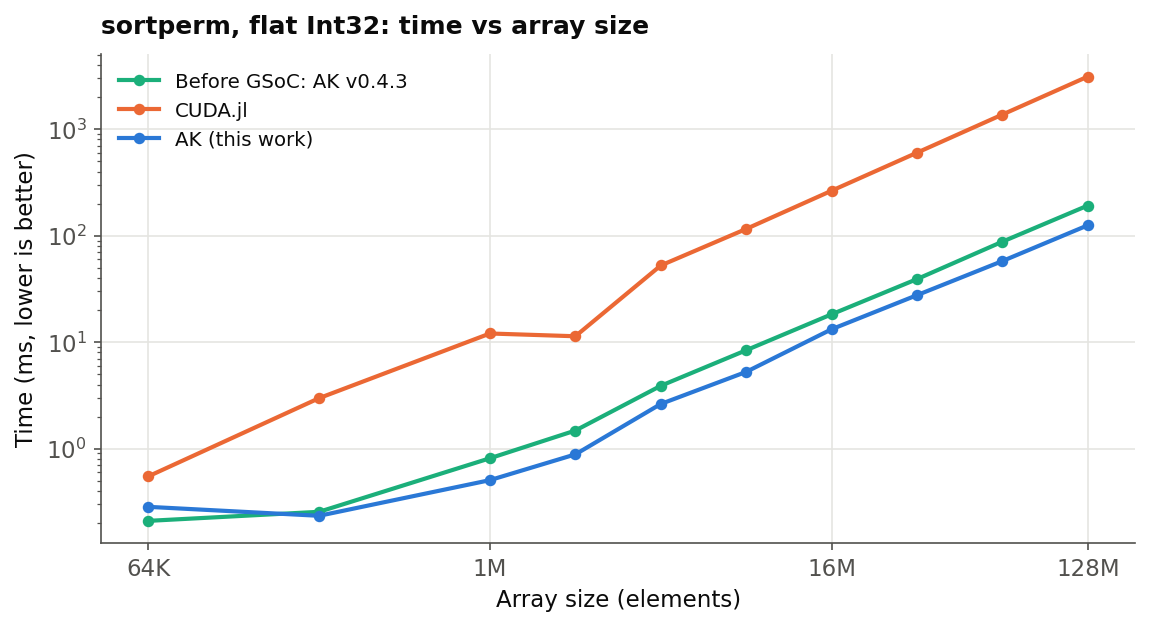
sortperm is faster than pre-GSoC AK by about 1.5 times at large sizes (191 ms to 125 ms at 128M Int32), and both are far ahead of the CUDA.jl sortperm, which is slow on the GPU.
accumulate
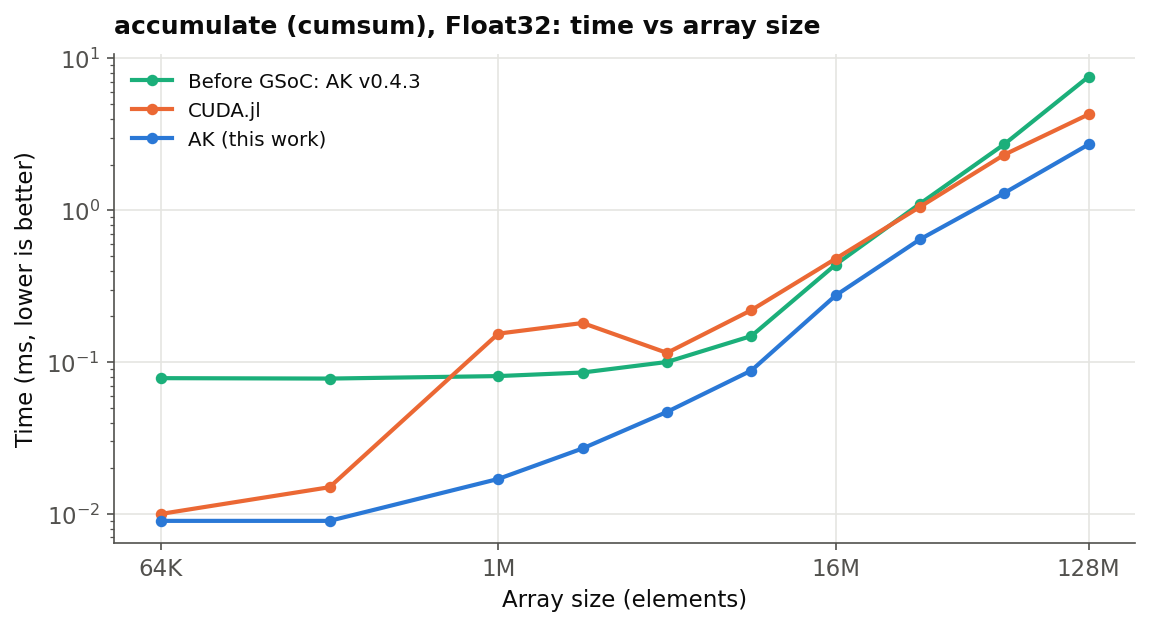
The scan rework is a clear win. The Float32 cumulative sum is about 2 to 3 times faster than pre-GSoC AK (7.6 ms to 2.7 ms at 128M), and faster than the CUDA.jl scan across sizes.
reduce and mapreduce
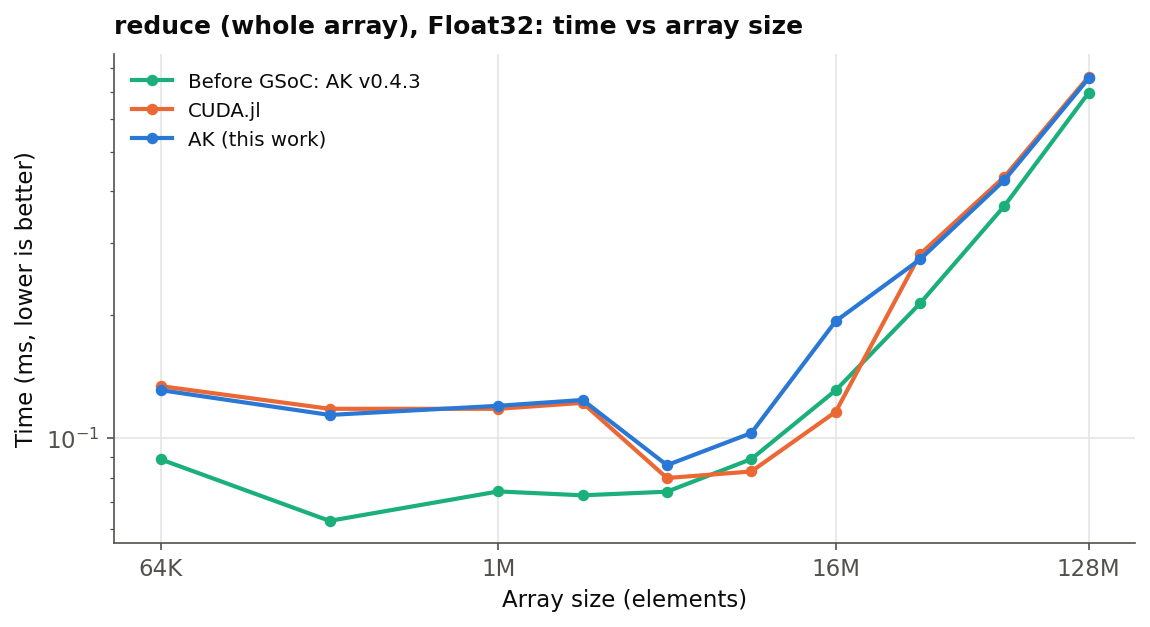
A whole-array reduction reads the input a fixed number of times, so it is limited by memory bandwidth. It was already at that limit in pre-GSoC AK, so the result is parity: the three lines sit together, with a slight mid-size dip in the current version that is tracked in #135.
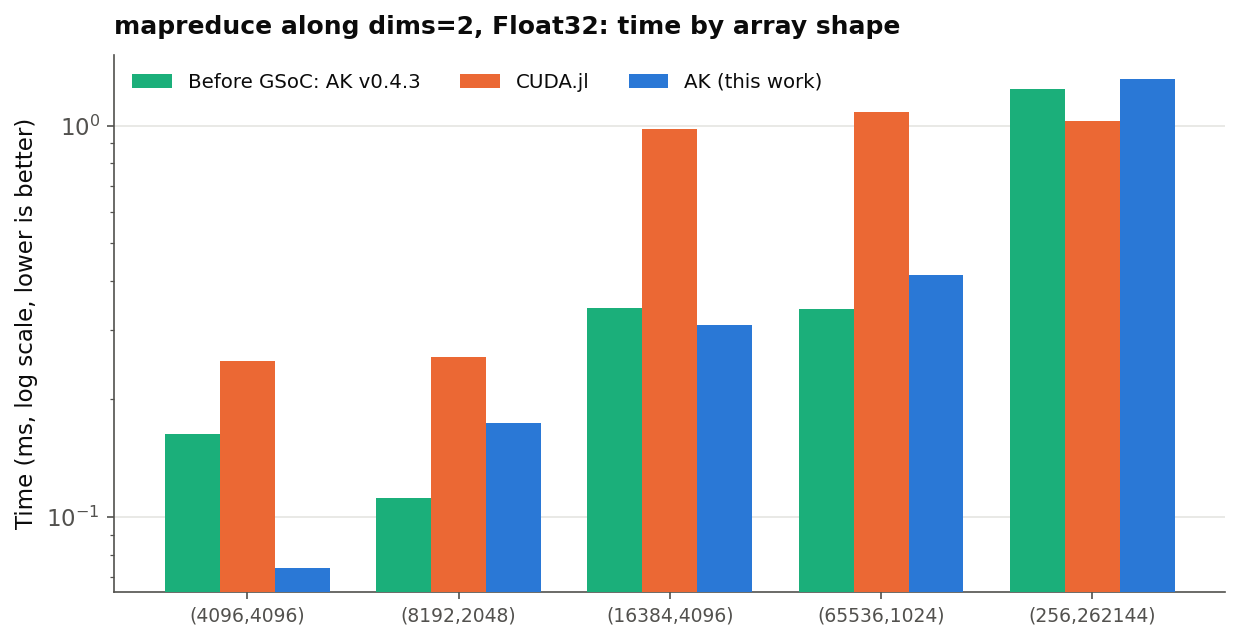
Reduction along a dimension is close to the pre-GSoC path per shape; PR #83 mainly widened which dimensions and shapes are handled rather than changing the per-shape time, and the result stays ahead of the CUDA.jl dims reduction on most shapes.
findall
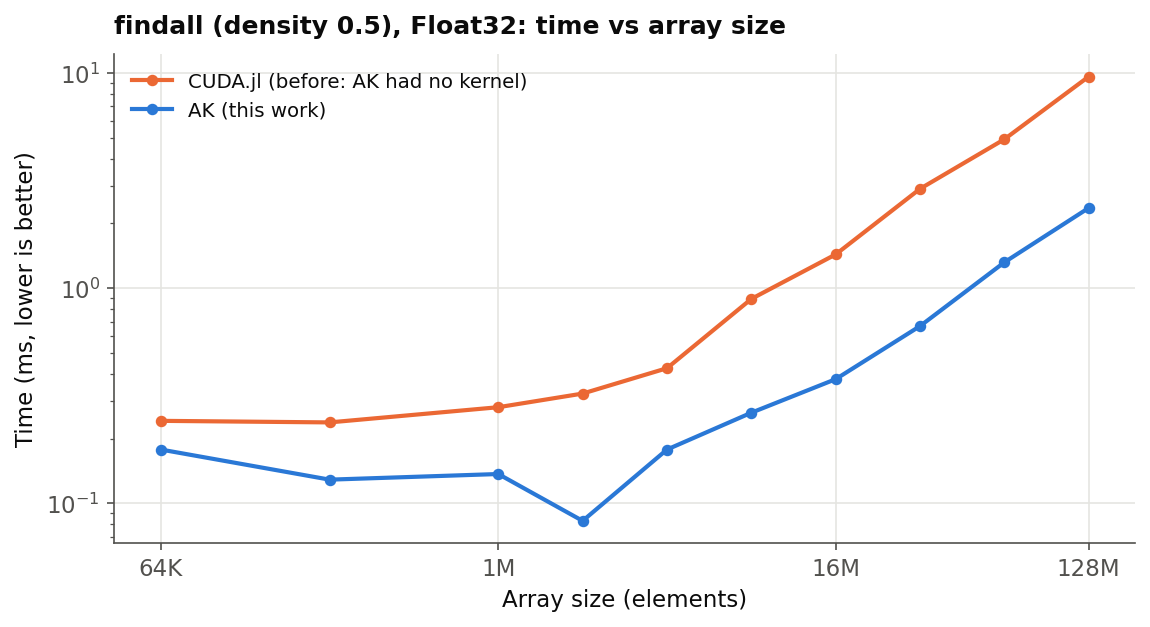
findall did not exist in AK before this project; it was added as a scan-based stream compaction. The chart compares it against the CUDA.jl findall you would have used instead, which it matches or slightly beats across densities.
reverse
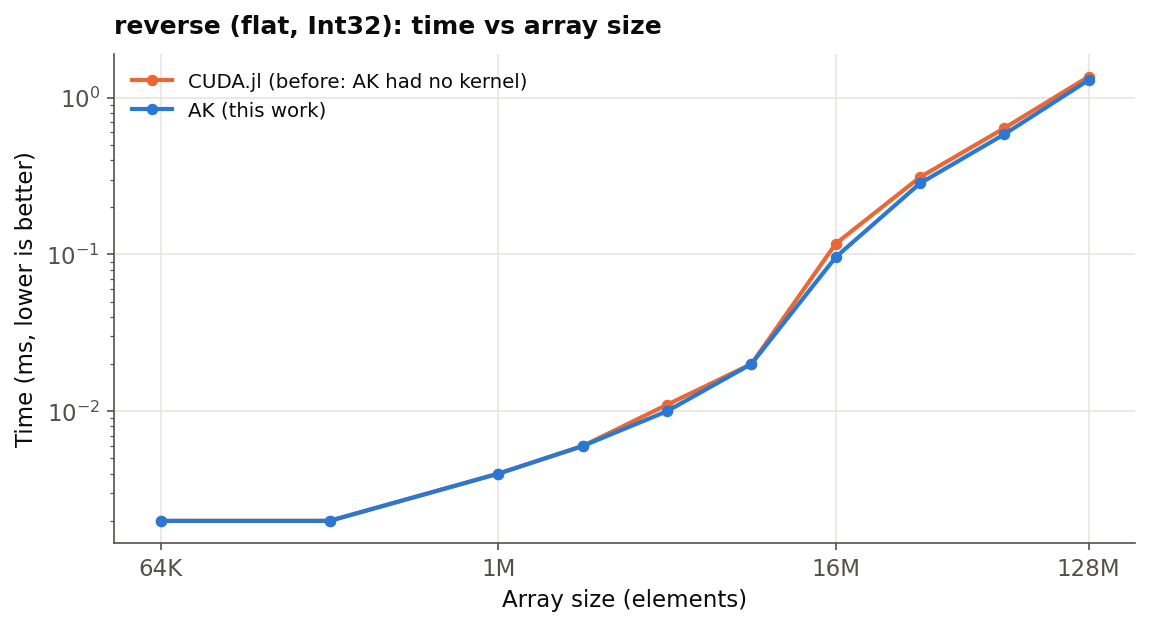
reverse was also new to AK. It is bandwidth-limited, so it sits at parity with the CUDA.jl reverse! that was the only option before.
map
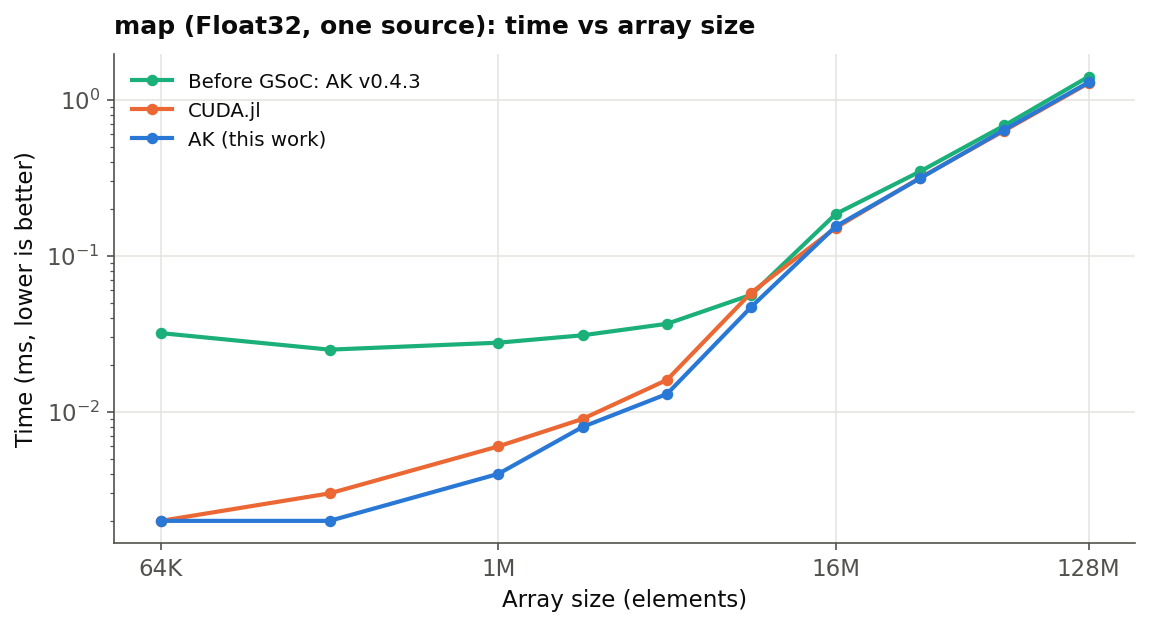
Single-source map is bandwidth-limited and sits at parity with pre-GSoC AK and the CUDA.jl map!. The new capability here is multi-source map and map!, which did not exist before.
Taken together: a real speedup where a better algorithm applies (RadixSort, the faster scan behind accumulate, and sortperm), new functionality where AK had nothing before (findall, reverse, BitonicSort, sorting and reducing along dims, multi-source map), and parity with no regression on the bandwidth-bound operations (reduce, map), which already ran at the memory limit.
What got merged upstream
All of the primitive work is merged and released in AcceleratedKernels.jl 0.5; the one AMDGPU.jl fix is merged there.
| PR | What it does |
|---|---|
| #83 | Dimensional mapreduce / reduce |
| #90 | Opt-in RadixSort via alg |
| #97 | Optimize radix sort |
| #102 | reverse! / reverse |
| #105 | Vectorized by-block reduce loads |
| #107 | items_per_thread for reductions |
| #108 | items_per_thread for scans |
| #114 | dims for reverse |
| #115 | findall (stream compaction) |
| #116 | Device-scope fence for DecoupledLookback |
| #117 | dims for sort / sortperm |
| #126 | BitonicSort |
| #129 | Segmented RadixSort along dims |
| #130 | Multi-source map / map! |
| AMDGPU.jl #1069 | Guard empty-array reverse launch |
Two measurement write-ups are recorded as open issues so the data lives in the repo: Int32 indexing in #149 and device-aware tuning in #150. The GPUArrays.jl delegation that consumes this work has merged as #790; it is maintained by Tim and builds on the AK 0.5 host-API rework, which also merged and shipped in 0.5.
Current state
Measured against the stated goals:
Missing primitives as portable AK kernels: done and merged.
reverse,findall,accumulate,mapreduceorreduce, and thesortandsortpermfamily are in AK 0.5 and run on every backend.dimssupport: done. Reductions, scans,reverse, andsorttakedims.Performance at least at parity: done, as the per-operation charts show.
Regression check: done, through the full benchmark run.
The GPUArrays.jl delegation merged in #790, which builds on the AK 0.5 host-API rework. A backend without a vendor method now uses the AK implementation.
Challenges and lessons learned
A single-pass scan needs a real device-scope fence. The decoupled-lookback scan that makes accumulate fast is a single pass in which blocks read each other's partial results, so it is correct only if every backend provides a device-scope memory fence between the write and the read. The first version passed on one backend and produced wrong results on another. The fix (#116) added a real device-scope fence on every backend. A memory-ordering assumption that holds on one vendor is not portable until it is checked on each.
GPU predicates have to stay type-stable. Building findall as a stream compaction (#115) failed to compile whenever the predicate closure captured a Type or returned a type-unstable value. I had to write the kernels so the predicate stays type-stable. GPU code is less forgiving than CPU code here, and the fix came down to being careful about what a device closure captures.
Edge cases show up only on real hardware. The out-of-place reverse failed when launched on an empty array, but only on AMD, and only when the tests ran on actual AMD hardware (AMDGPU.jl #1069). Portability work needs to run on each backend.
Measure before adding complexity. Two changes that looked promising, a shfl_down subgroup reduction and Int32 index arithmetic, gave no improvement once measured, because both operations are limited by memory bandwidth rather than by the part being changed. Measuring them early kept that complexity out of the code. A recorded negative result is as useful as a positive one.
The main lesson is that portability and performance are compatible once the algorithm fits the operation. The compute-bound operations improve because one portable kernel can use a work-efficient algorithm that each backend would otherwise reimplement. The bandwidth-bound operations reach parity because they are limited by memory bandwidth: once a kernel already saturates the memory bus, there is no headroom left to beat, so matching the vendor path is the best result available rather than a shortfall.
What is left
Device-aware
Autotuning. The per-backend override belongs in a package extension through thereduce_tuningandsort_tuninghooks. Now that the AK host-API rework has landed, this can be added without a full autotuner. Data in #150.Narrow-integer (
Int32) indexing. This is being handled at the GPU compiler level (by Tim) by addingllvm.assumerange hints so the compiler narrowsi64toi32with no source changes. In a memory-bound regime the effect is small. Measurements in #149.Small and whole-array reductions. A known slowdown is tracked in #135, which I am looking into.
GPUArrays on top of AK. The larger plan is to build GPUArrays.jl on top of AK so backends no longer depend on it directly. The first delegation PR #790 has merged, and more operations can follow the same path.
Thanks to Tim Besard and Christian Guinard for their mentorship, and to the JuliaGPU community.